

Jungian Arts-Based Research
What is it and why am I so obsessed with it?

When I encountered Jungian Arts-Based Research (JABR) in grad school (God Bless you, Susan Rowland!) it explained succinctly and poetically the way I intrinsically felt about making art.
In the most reductive definition to me it means - use everything and the process is the product. And since I am transitioning from someone who wrote purely personal narrative, basing my (auto) fiction on a JABR framework is the evolutionary next step. But I want to be explicit about it. And not only that, I want to document the process in real time. This is the kind of nerd I am. You are welcome fellow nerds. I see you.
I learned about JABR at Pacifica Graduate Institute, where I completed my MA in Depth Psychology and Creativity. Susan Rowland - one of the primary architects of JABR - describes it as bringing “art making, knowledge making, and individuation into a transformational temenos for the single artist or a collaborative group”. Temenos is a Greek word for sacred precinct. The container where the muse arrives.
I know about temenos. I created it for over a decade in violent spaces so people could drop in and connect authentically to each other through shared stories.
Rowland didn’t invent ABR. The field was named and institutionalized by Elliot Eisner at Stanford in the 1980s and 90s, who insisted that art could be social science and social science could be artful. Shaun McNiff brought the body and the image into it - art not as data representation but as the instrument of knowing itself. Patricia Leavy systematized it across disciplines from sociology to public health to literary fiction. Rowland’s Jungian fork is where it gets interesting for me: the paradigm shift that says active imagination, dream, synchronicity, and symbol-making are not decorative. They are epistemological. They are how we know things.
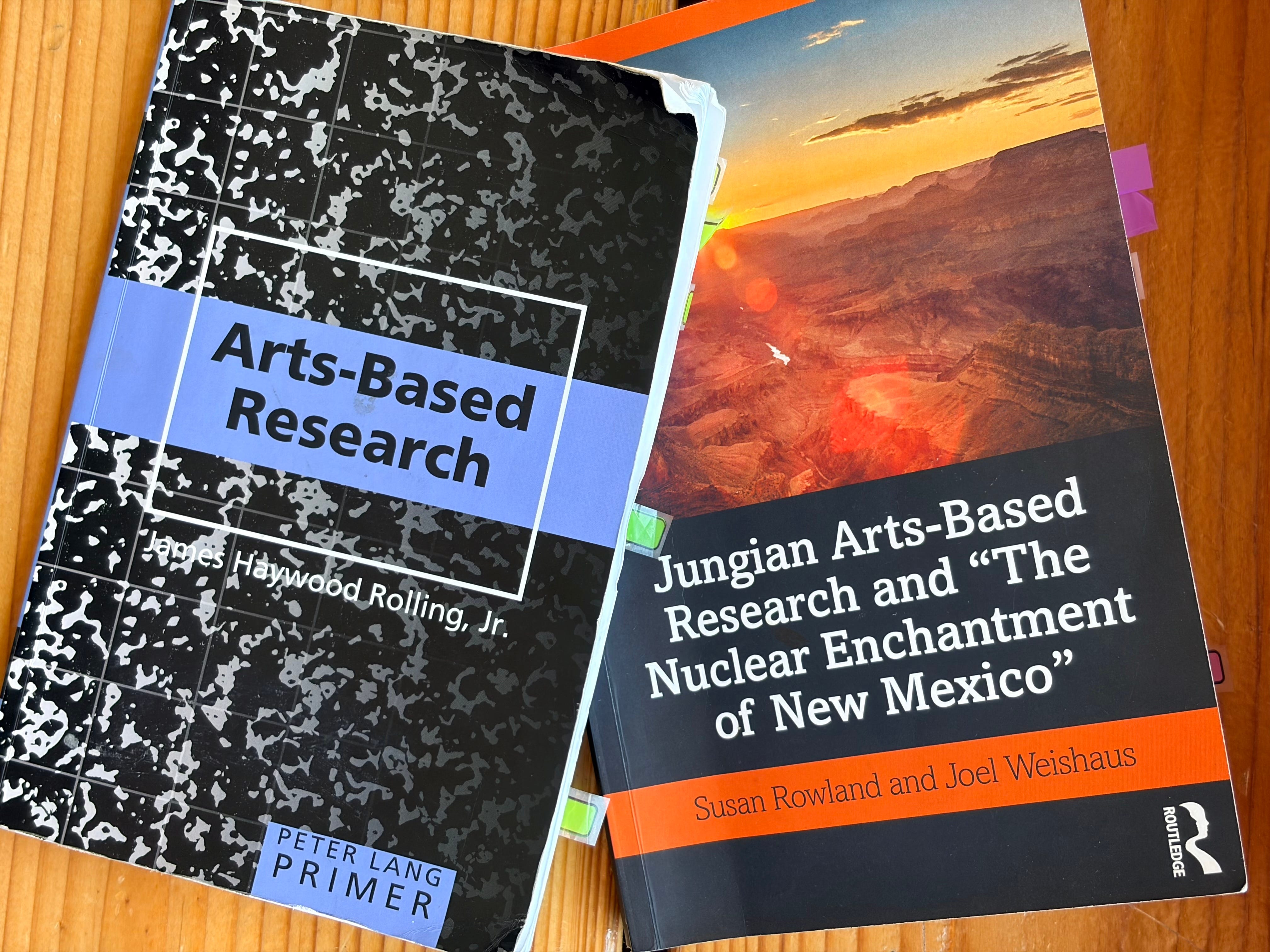
James Haywood Rolling Jr., whose Arts-Based Research Primer (Peter Lang, 2013) gave the field its working structure, describes ABR as “an artistic method of research, one that arguably predates the scientific method” - four overlapping modes: analytic, synthetic, critical-activist, and improvisatory. I’ll certainly be veering into the improvisatory realm where “thinking evolves reflexively and the self becomes both the site and instrument of research and learning.” His framework is the skeleton. Rowland put the Jungian psyche into it. Together, what they describe is what I have always done, without knowing it had a name. Hence, use everything.
JABR is not art therapy. Rowland is clear on this distinction and I am clearer: art therapy uses creativity to heal the patient. JABR uses art “as an ontology, or basis, for being and knowing”. The art goes into the world. It becomes autonomous. It generates meaning after you’re finished with it - in other cultures, other centuries, other readers who have nothing to do with your original wound. The wound, not to be forgotten or ignored, but mined for symbolism, pattern making, and inspiration.
The wound is the entry point, not the destination.
When I tell people I’m writing a novel about an Iron Age woman who had her tongue cut out, they nod politely. When I tell them the novel is also archaeological research, alchemical process mapping, active imagination sessions, tarot pulls synchronized to the manuscript’s thematic spine, and a year-long devotional practice to a proto-Celtic goddess - they stop nodding. They don’t have a category for that.
But now they do.
Here’s what it looks like from inside.
Salt is the first novel in a trilogy structured on the Paracelsian tria prima of alchemy - Salt, Sulfur, Mercury. The central character in Salt is Nisia, a mute Durotrigian woman living near Maiden Castle in Dorset, circa 43 CE, at the edge of the Roman invasion. I chose her because my DNA matched a skeleton in her burial ground. The Cassidy et al. Nature study (2025) confirmed that the Winterborne Kingston burial site - where that skeleton was found - was matrilocal: women stayed, men moved. She is, quite literally, my ancestor. She chose her muteness. Or rather, she showed me her tongue was cut out early on and I went with it. The realization that I am writing about a mute woman when the entire series is about women silenced by patriarchy is not lost on me.
That’s not a conceit. That’s synchronicity. And in JABR, synchronicity is data.
So here is what I am documenting, in real time, in this essay and the ones that follow: what it looks like to write a novel as a research practice. What it means when the alchemical operation you’re writing about is also the operation you’re undergoing. When the process and the product are not separate things, have never been separate things, and the insistence that they should be is a property of modernity’s subject/object split - the same split JABR exists to dismantle.
The Morrigan watches. She always watches. That is her function - crow on the battlefield, witness to what is actually happening, not what we’d prefer to believe. I’m going to try to write as honestly as she sees while being guided by Brigantia in her firm but loving ways.
This is the work. Join me.
Works Cited
Rolling, James Haywood, Jr. Arts-Based Research Primer. Peter Lang, 2013.
Rowland, Susan. “Jungian Arts-Based Research: Doing Therapy With the World.” jung.org, Jung Society of Washington, 30 May 2023, jung.org/news/blog/18/18-Jungian-Arts-Based-Research-Doing-Therapy-With-the-World-by-Susan-Rowland.
Rowland, Susan, and Joel Weishaus. Jungian Arts-Based Research and “The Nuclear Enchantment of New Mexico.” Routledge, 2021.